
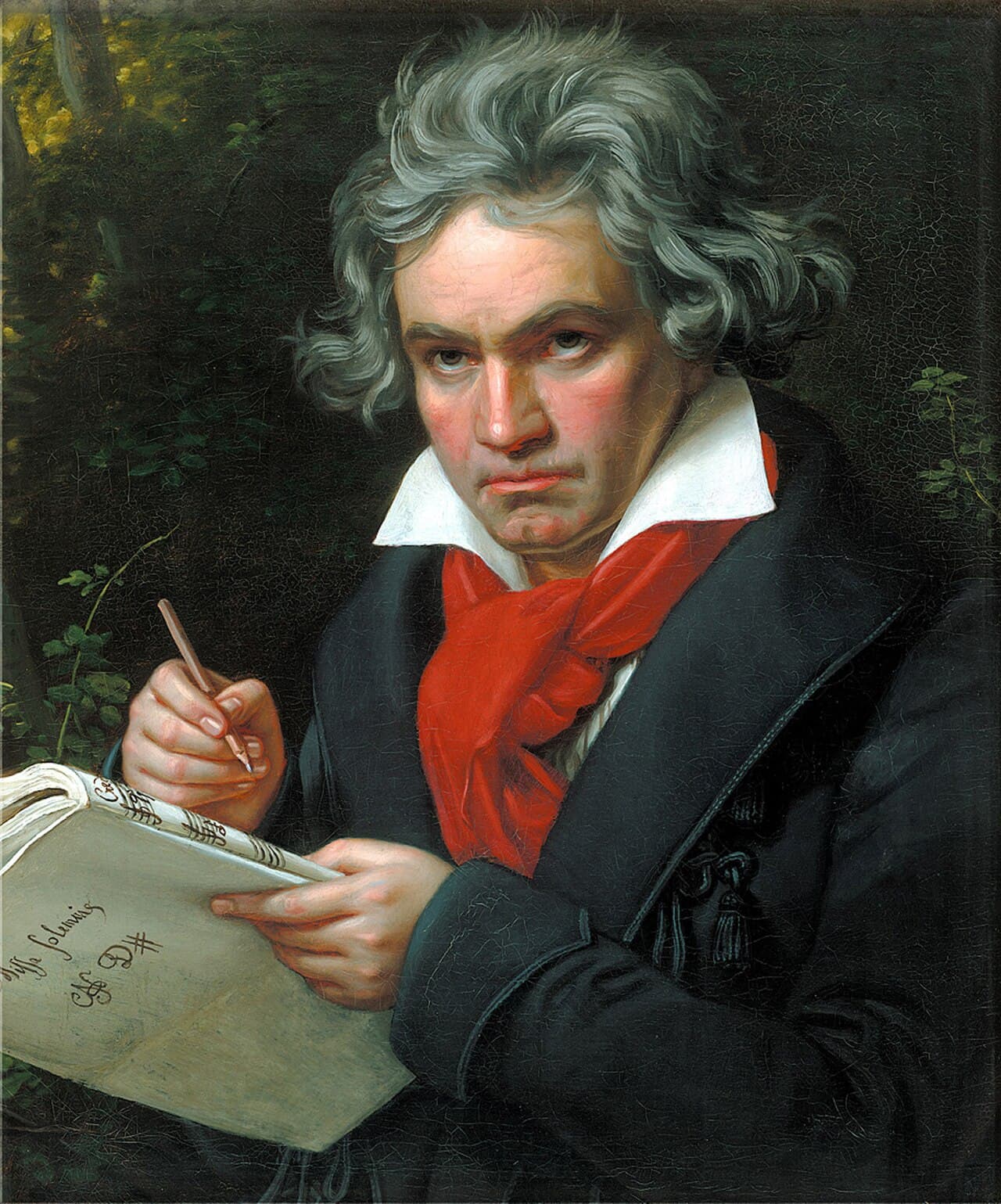
In October 1802, Ludwig van Beethoven found himself in Heiligenstadt, a small village outside Vienna. He was thirty-one years old and confronting a personal crisis that would have ended many careers. At his physician's suggestion, he had sought refuge in the countryside to address his deteriorating hearing. For the past five years, Beethoven had been experiencing a progressive loss of hearing, accompanied by tinnitus—a constant 'whistling and humming' that plagued him day and night. His social life was suffering; he could no longer follow conversations in crowded rooms, and attending concerts had become an ordeal, as he struggled to hear the instruments unless he was in close proximity. The composer, whose life was devoted to music, found himself increasingly isolated by his condition. It was during this retreat that he penned the Heiligenstadt Testament, a letter addressed to his brothers, Carl and Johann, which he never sent. This document, discovered among his belongings after his death in 1827, is a poignant confession of despair. Beethoven admitted to having contemplated suicide, restrained only by the compulsion to fulfill his artistic potential. He resolved to endure, driven by the conviction that he must compose all the music within him before he could consider death. That same year, he completed his Second Symphony, a work of striking vitality that belies the despair from which it emerged. Over the next twenty-five years, Beethoven would go on to compose some of the most profound music ever written, including the Ninth Symphony and the late string quartets, all while his hearing continued to decline.
What he was hearing
Beethoven’s hearing loss is one of the most well-documented medical conditions in the history of music, largely because the composer himself wrote extensively about it in his letters. He corresponded with his friend Franz Wegeler, a physician, as well as his publisher, Breitkopf & Härtel, and his patron, Archduke Rudolph, among others, detailing the progression of his affliction. The medical records from his consultations with Vienna’s physicians add further context. The clinical picture points to bilateral progressive sensorineural hearing loss, which commenced in Beethoven's late twenties, around 1796-1798. The loss primarily affected high frequencies before progressing to lower ones, and was accompanied by both tinnitus and recruitment—a heightened sensitivity to loud sounds. By approximately 1817-1818, Beethoven was completely deaf.
The cause of Beethoven’s deafness has intrigued and puzzled medical historians for two centuries. Otosclerosis, an abnormal growth of bone in the middle ear, is the most widely accepted explanation. This condition, which impairs sound transmission, fits the age of onset and the slow progression of his symptoms. Other theories have been considered: lead poisoning is plausible, given that Beethoven consumed cheap Hungarian wines known to contain lead. In 2000, William Walsh's analysis at Argonne National Laboratory found elevated lead levels in Beethoven’s hair samples. However, most ear specialists argue against lead poisoning being the primary cause, as the pattern of hearing loss does not align with lead-induced deafness. Syphilis, typhoid, autoimmune ear disease, and congenital factors have also been proposed, but none are conclusively supported by the evidence. The recent 2023 genomic analysis conducted by Tristan Begg and the Beethoven Genome Project, published in *Current Biology*, identified genetic variants that might predispose to liver disease, but no definitive markers for hearing loss. Thus, while the clinical details of his hearing loss are well understood, its precise etiology remains elusive.
How he composed when he could not hear
The enigma of how Beethoven continued to compose during his years of profound deafness has fascinated music historians and laypeople alike. The simplest answer lies in his ability to hear music internally, a skill not uncommon among composers but one that Beethoven possessed to an extraordinary degree. Even as his auditory world dimmed, his mind remained vividly alive with sound. Beethoven could conceptualize complex musical structures entirely in his imagination, hearing every instrumental line, every harmonic progression, every rhythmic gesture with clarity. His correspondence suggests that he had cultivated this mental faculty over years, a testimony to his dedication and innate musical genius.
Beethoven's extensive use of sketchbooks provides a window into his compositional process. Over 200 of these sketchbooks survive, offering a detailed account of how he developed his works. The Ninth Symphony alone, which took six years to compose, fills several volumes. These books reveal a meticulous process of drafting, revising, and refining, with variations and alternatives spilling into the margins until he achieved the desired effect. During his deaf years, Beethoven also relied heavily on conversation books—small notebooks where visitors wrote their side of the conversation, as Beethoven could no longer hear them. Approximately 130 of these books survive, documenting the texture of his daily life, from mundane details to profound discussions about art. However, they capture little of Beethoven's own voice; the visitors would write, and he would reply orally, leaving his responses unrecorded. This absence underscores the isolation that defined his later years, as he navigated a world he could no longer hear.
What the music changed
Beethoven's oeuvre is often divided into three stylistic periods, which intriguingly align with the progression of his hearing loss. His 'early' period (circa 1790-1802) is characterized by works that adhere to the classical traditions of Haydn and Mozart, marked by clarity, balance, and structural elegance. Following the Heiligenstadt crisis, Beethoven entered his 'middle' period (circa 1803-1812), during which he produced music of greater emotional depth and complexity. Works such as the Eroica Symphony, the Fifth Symphony, and the Razumovsky Quartets exemplify this phase, known for its heroic and expansive qualities.
The 'late' period (circa 1816-1827), coinciding with Beethoven's complete deafness, ushered in a radically innovative musical language. This era includes the late piano sonatas, the Missa Solemnis, the Ninth Symphony, and the late string quartets. The late works are distinguished by their structural freedom, harmonic audacity, and emotional intensity. Beethoven expanded and compressed musical time, explored unconventional key relationships, and combined intricate polyphony with moments of stark simplicity. He pushed traditional forms to their limits: for instance, the original finale of the Op. 130 quartet, the Grosse Fuge, is a colossal structure that challenges conventional quartet norms. Whether this late style emerged because of his deafness or was merely coincidental remains a topic of scholarly debate. Some argue that the isolation fostered by his deafness allowed Beethoven to explore a more introspective and unconventional musical voice. Others suggest that the late style was an extension of tendencies already present in his middle period, accelerated perhaps by his condition but not caused by it. What is undeniable is that this music, created in the silence of his deaf world, is among the most profound in the Western canon.
The Ninth Symphony premiere
The premiere of Beethoven’s Ninth Symphony on 7 May 1824, at Vienna's Kärntnertortheater, remains a milestone in the history of music. Despite being completely deaf, Beethoven attended rehearsals, seated beside the conductor, Michael Umlauf, to convey his intentions through gestures and notes. The orchestra and chorus faced the formidable task of performing a work of unprecedented scale, with parts hastily copied and still containing errors. The difficulty was palpable, yet the performance proceeded, culminating in a moment that would be forever etched into musical lore.
As the symphony concluded, Beethoven, who had been following along with his score, remained unaware of the audience's response. The contralto, Caroline Unger, recognizing his isolation, approached him and turned him to face the audience. Only then did Beethoven comprehend the thunderous applause that filled the theater. This poignant moment, captured in the memoirs of those present, underscores the paradox of his genius: a composer who could create such monumental works while residing in a world of silence. The Ninth Symphony has since become a universal symbol of unity and triumph, performed on significant occasions worldwide, including the fall of the Berlin Wall in 1989, where Leonard Bernstein famously altered the 'Ode to Joy' text to celebrate freedom. Beethoven, who could not hear the applause in 1824, had crafted a legacy that resonates through the ages.
The medical detective work since his death
Beethoven passed away on 26 March 1827, aged 56, succumbing to complications of cirrhosis. His death prompted immediate medical interest, culminating in an autopsy conducted by Dr Johann Wagner and Dr Karl Rokitansky the following day. Their report, preserved in Vienna's medical archives, documented extensive liver damage, an enlarged spleen, and thickening of the temporal bones, which are consistent with otosclerosis—a likely contributor to his deafness. The auditory nerves were described as 'shrivelled,' suggesting significant inner-ear damage.
Modern scientific techniques have allowed for further exploration of Beethoven's ailments. His preserved hair samples have been subjected to chemical analysis, leading to the 2000 discovery of elevated lead levels, and more recently, the 2023 genomic study by Tristan Begg and colleagues, published in *Current Biology*. This study provided insights into his genetic predisposition to liver disease, yet did not identify a definitive genetic cause for his hearing loss. The evidence points toward otosclerosis as the primary factor, with possible contributions from environmental and genetic factors. The quest to understand Beethoven's medical history continues, with the emphasis shifting from his deafness to the broader context of his health, including the liver disease that ultimately ended his life.
The legacy of Ludwig van Beethoven is one of enduring fascination and inspiration. His music—the symphonies, quartets, piano sonatas, concertos, and choral works—continues to be a cornerstone of the Western classical repertoire. Each performance is a testament to the transformative power of art, as audiences around the world experience the profound emotional and intellectual depths of his compositions. Beethoven's work redefined the forms in which he composed, setting a standard to which subsequent composers have aspired. Though he could not hear the Ninth Symphony at its premiere, his imagination and creative will transcended his physical limitations. Two centuries of listeners have heard what he could not, as the music he imagined and wrote down continues to resonate, inviting us into the silent world where it was born.
References
- Solomon, M. (1998). Beethoven (2nd revised edition). Schirmer Books.
- Begg, T. J. A., et al. (2023). Genomic analyses of hair from Ludwig van Beethoven. Current Biology, 33(8), 1431–1447.
- Lockwood, L. (2003). Beethoven: The Music and the Life. W. W. Norton.
- Mai, F. M. (2007). Diagnosing Genius: The Life and Death of Beethoven. McGill-Queen's University Press.


