

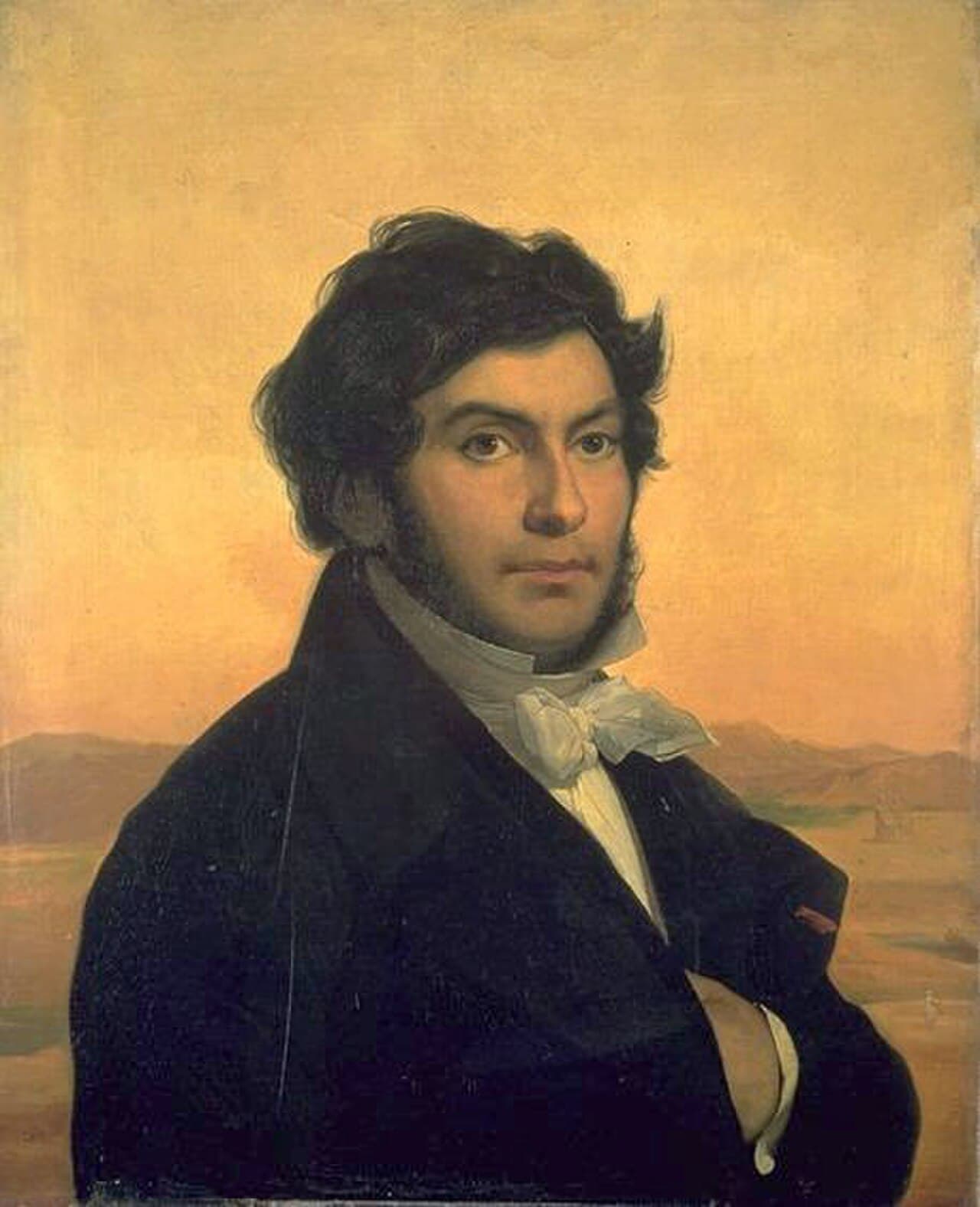
On 14 September 1822, Jean-François Champollion, a 31-year-old French linguist, burst into his brother Jacques-Joseph's office at the Institut de France in Paris, shouting 'Je tiens mon affaire!' — 'I've got it!' — before collapsing into unconsciousness. This dramatic event marked the culmination of a lifelong obsession with the ancient Egyptian scripts, one that would render the hieroglyphs comprehensible for the first time in over a millennium. Champollion remained unconscious for five days, a testament to the mental and physical toll of his discovery. Upon his recovery, he composed the 'Lettre à M. Dacier', which was presented to the Académie des Inscriptions et Belles-Lettres on 27 September 1822. In this letter, he announced his breakthrough: the phonetic principles underlying Egyptian hieroglyphic writing had been decoded. This discovery laid the foundation for modern Egyptology, as hieroglyphs had been indecipherable since the last known inscription was carved in 394 CE.

What had been lost
Egyptian hieroglyphs were a script used continuously for over three millennia, beginning around 3200 BCE. However, by the late Roman period, their use declined as Egypt underwent significant cultural shifts. The last known hieroglyphic inscription, dated to 24 August 394 CE, was carved at the Philae temple, marking the end of an era. As Egypt became increasingly Christianised, the hieroglyphic script fell out of use, replaced by Coptic, which employed a modified Greek alphabet. By the medieval period, hieroglyphs had become a lost language to Europe and even largely within Egypt itself.
Athanasius Kircher, a 17th-century Jesuit polymath, was among the early European scholars who attempted to interpret hieroglyphs. His works, produced in the 1650s, gained considerable attention despite being entirely incorrect. Kircher believed hieroglyphs were symbolic representations of philosophical ideas rather than a phonetic script. This misconception persisted until the discoveries of the 19th century, when scholars like Champollion finally began to peel back the layers of misunderstanding and reveal the phonetic nature of the script.
The Rosetta Stone
The pivotal moment in the story of deciphering hieroglyphs came during Napoleon's Egyptian expedition in July 1799. A French engineer, Pierre-François Bouchard, was overseeing fortification work at Fort Julien near Rashid (Rosetta) in the Nile Delta when he unearthed a remarkable artifact: the Rosetta Stone. This black granodiorite slab bore inscriptions in three scripts: hieroglyphic, demotic, and Greek. The stone contained a decree issued in 196 BCE during the Ptolemaic era, and its trilingual nature hinted at the possibility of translation. Although the Greek text could be read immediately, the hieroglyphic and demotic scripts remained a mystery.
The Rosetta Stone was subsequently seized by the British following Napoleon's defeat and transported to the British Museum in 1802, where it remains today. It became a focal point for scholars eager to unlock the secrets of ancient Egypt. The presence of a known Greek text alongside the unknown scripts provided a vital tool for comparison and analysis, setting the stage for the work of future scholars like Thomas Young and Jean-François Champollion.
Who worked on it before Champollion
Before Champollion's breakthrough, several key figures made significant contributions to the study of the Rosetta Stone. Antoine-Isaac Silvestre de Sacy, a professor of oriental languages in Paris, made initial attempts to interpret the demotic text but without success. His efforts, however, paved the way for others to build upon. Johan David Åkerblad, a Swedish diplomat and linguist, made notable progress in 1802 by identifying several proper names in the demotic script and deciphering most of the alphabetic demotic signs.
The English physicist and polymath Thomas Young also played a crucial role between 1814 and 1819. Young correctly identified that several cartouches, oval frames surrounding royal names, in the hieroglyphic text spelled 'Ptolemy' phonetically. He also recognised the relationship between hieroglyphic and demotic scripts. However, Young's work was incomplete and partly inaccurate. The rivalry between Young and Champollion over the decipherment credit was intense, with both scholars contributing significantly, yet ultimately, it was Champollion who made the decisive breakthroughs that advanced the field.
What Champollion brought
Champollion's approach to deciphering the hieroglyphs was distinct in two critical ways. First, from the age of 14, he had immersed himself in the study of Coptic, the direct descendant of ancient Egyptian. Living in Paris, he engaged with a community of Coptic-speaking Egyptian Christians, gaining a linguistic foundation that proved invaluable. Champollion understood that if the hieroglyphs encoded a language, it would be one closely related to Coptic. The lexicon and grammar of Coptic could thus serve as a check on any proposed readings of the ancient script.
Second, Champollion was obsessively dedicated to the problem. By 1822, he had spent over a decade studying hieroglyphs, memorising the Rosetta Stone's text and as many other inscriptions as he could access. His relentless pursuit of understanding, combined with his linguistic skills, set him apart from his contemporaries. Champollion's comprehensive knowledge of the material and his linguistic insight were the keys that would eventually unlock the ancient script's secrets.
The September 1822 breakthrough
The breakthrough on 14 September 1822 came after Champollion received a copy of an inscription from Abu Simbel. While examining it, he realised that a cartouche he initially thought contained a foreign name actually included native Egyptian elements. The name he read as 'Ramses' was composed of three signs: a sun-disk (ra), a hatching figure (mes), and the doubled determinative (es). Each symbol represented a phonetic sound rather than a purely symbolic idea. This realisation that the system was mixed — phonetic and symbolic — was revolutionary. The hieroglyphic script was logo-phonetic, involving sounds, whole words, and determinatives that clarified meanings.
This revelation allowed Champollion to apply the pattern to other royal names, unlocking further inscriptions in rapid succession. Within hours, he had deciphered several more texts. Over the next two years, he produced the first comprehensive grammar and dictionary of the ancient Egyptian language, establishing a framework that would support the nascent field of Egyptology.
What he did afterwards
Champollion's health suffered greatly after his groundbreaking work in 1822, and it never fully recovered. Despite this, he continued his scholarly efforts, publishing the 'Grammaire égyptienne' and the 'Dictionnaire égyptien' posthumously with the help of his brother. In 1828, he embarked on an expedition to Egypt, where he read hieroglyphic inscriptions aloud from temple walls, astonishing local guides who believed the script was magical and unreadable.
Champollion's journey to Egypt was both a triumph and a testament to his tenacity. However, his relentless work came at a cost. He passed away on 4 March 1832, at the age of 41, from a stroke likely worsened by exhaustion. Despite his premature death, his grammar and dictionary became the cornerstone of Egyptology, enabling future scholars to build upon his foundational insights.
Before Champollion's decipherment, the understanding of ancient Egypt in Europe was piecemeal, reliant on sources like Herodotus, the Bible, and Roman writers. These accounts, though valuable, were secondhand, often mythologised, and incomplete. Champollion's work transformed this landscape by unlocking the actual texts of ancient Egypt. Administrative records, religious texts, autobiographical inscriptions, medical papyri, and literary compositions from three millennia of Egyptian civilisation suddenly became accessible.
The decipherment was not merely a scholarly achievement; it was the rediscovery of a civilisation's voice. Works such as the Pyramid Texts, the Book of the Dead, and the letters of workmen from Deir el-Medina were now readable, providing unparalleled insights into the lives, beliefs, and practices of the ancient Egyptians. Champollion's contribution was a watershed moment in history, one that bridged the gap between ancient and modern understandings of one of humanity's oldest civilisations.
References
- Robinson, A. (2012). Cracking the Egyptian Code: The Revolutionary Life of Jean-François Champollion. Oxford University Press.
- Champollion, J.-F. (1822). Lettre à M. Dacier, secrétaire perpétuel de l'Académie royale des inscriptions et belles-lettres. Imprimerie de Firmin Didot, Paris.
- Parkinson, R. (1999). Cracking Codes: The Rosetta Stone and Decipherment. British Museum Press.
- British Museum. The Rosetta Stone, Object EA 24.


