
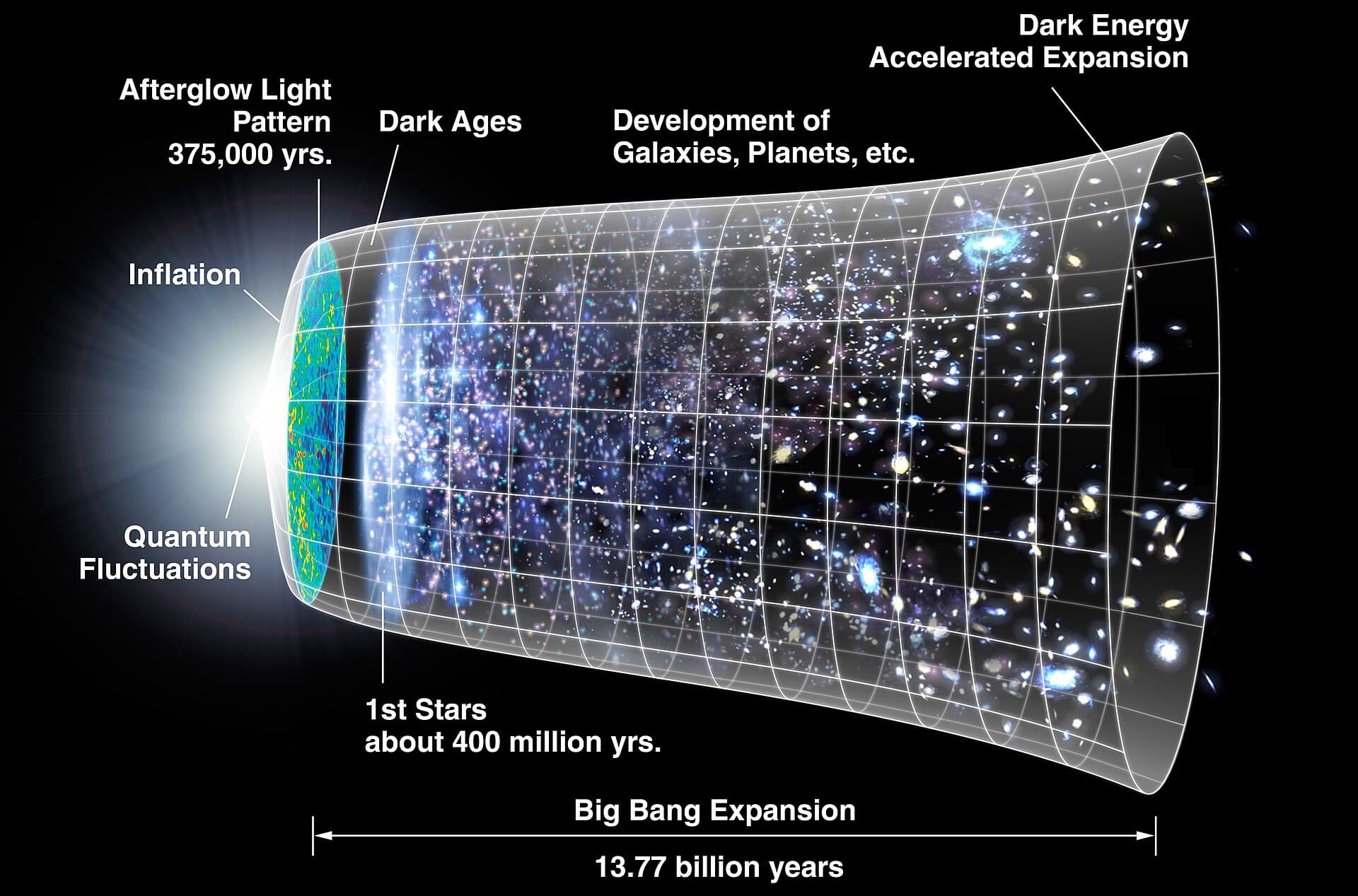
The universe, as we observe it today, has evolved over approximately 13.8 billion years. Yet, remarkably, the foundational physics that determined its overall structure and behaviour was almost entirely set within the first fleeting second after the Big Bang. In that initial, almost infinitesimally brief epoch, the universe underwent transformations that would dictate the future development of galaxies, stars, and ultimately life itself. This dizzyingly rapid sequence of events saw the emergence of baryons, the separation of the four fundamental forces, and a particle mix that, over the ensuing 400,000 years, would cool enough to form atoms. To appreciate the profound significance of this first second, we must traverse it in the order of occurrences, examining each pivotal moment.
The Planck epoch (0 to 10⁻⁴³ s)
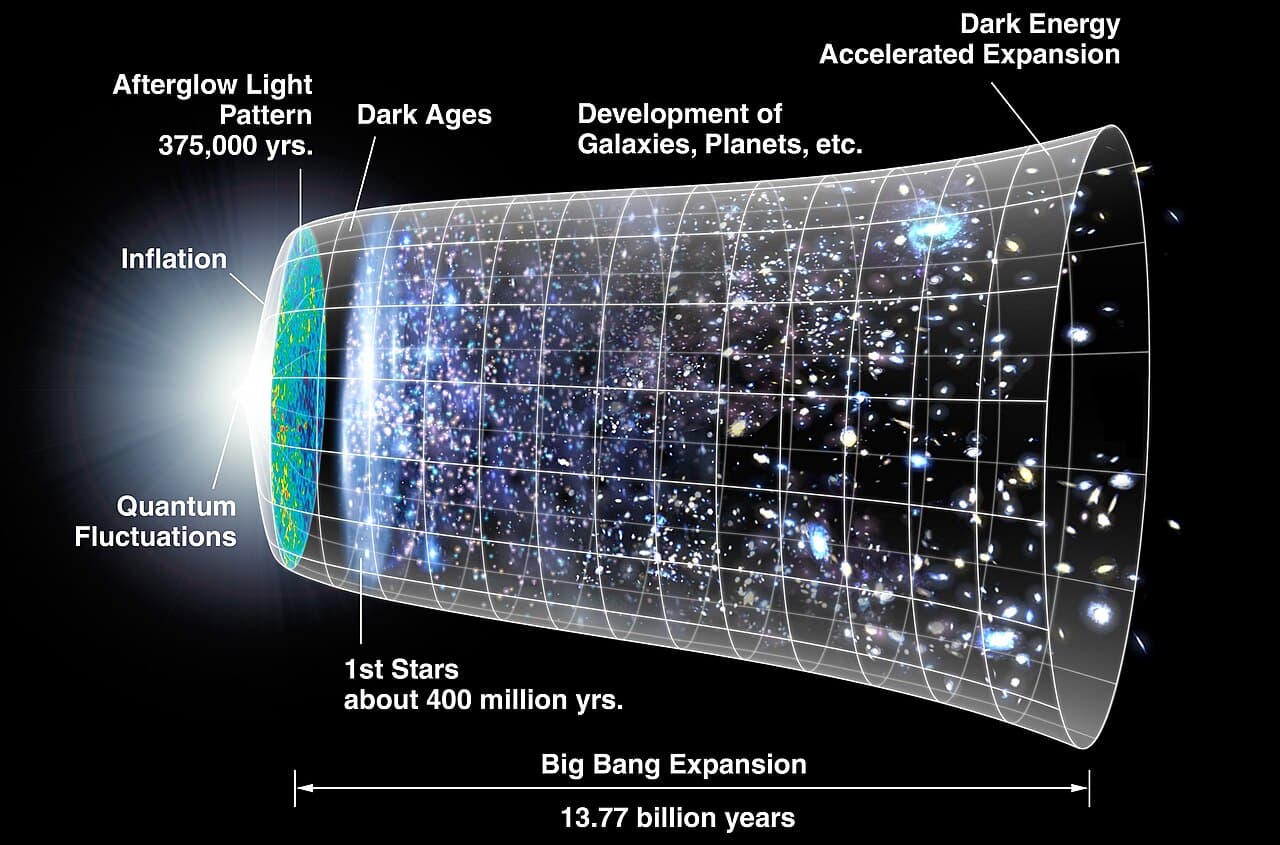
The Planck epoch represents the earliest period of the universe, a time so extreme that our current theories break down under its conditions. During these first 10⁻⁴³ seconds, the universe was unimaginably hot and dense, with temperatures around 10³² Kelvin and a linear size of about 10⁻³⁵ metres. All four fundamental forces—gravity, electromagnetism, the weak nuclear force, and the strong nuclear force—were unified. However, our lack of a quantum theory of gravity leaves this epoch shrouded in mystery, as even the most robust models struggle to describe it accurately. Instead, the language used to depict this moment serves more as a placeholder, awaiting a future theory that might offer clarity.
As this epoch ended, the universe began to cool slightly, setting the stage for the next significant transformation. Gravity, the weakest of the forces but the most pervasive at large scales, separated from the other unified forces. This marked the transition to what is known as the Grand Unification epoch, where gravity stood apart, and the remaining forces continued to exist in a unified state.
Grand unification (10⁻⁴³ to 10⁻³⁶ s)
During the Grand Unification epoch, the universe's temperature had reduced to around 10²⁸ Kelvin. Gravity had already decoupled, but the strong nuclear force, the weak nuclear force, and electromagnetism remained unified under what theoretical physicists refer to as grand unified theories (GUTs). The concept of grand unification is one of the significant pursuits in theoretical physics, seeking to describe the interactions of these forces under a single framework.
As the universe continued its expansion and cooling, another phase transition occurred. The strong nuclear force separated from the electroweak force—a combination of the electromagnetic force and the weak nuclear force. This separation released energy in a manner reminiscent of how water freezes, undergoing a phase transition that similarly liberates latent heat. These transformations were crucial for the subsequent evolution of the universe, setting the conditions for what was to come during the inflationary period.
Inflation (10⁻³⁶ to 10⁻³² s)
The inflationary epoch is one of the most intriguing and perplexing periods in the early universe, marked by a rapid and dramatic expansion. Proposed by Alan Guth in 1981, inflation suggests that the universe expanded exponentially, increasing its linear size by a factor of at least 10²⁶ within a mere 10⁻³⁴ seconds. This brief burst of expansion solved several significant problems inherent in the Big Bang model, notably the horizon problem, which questions how distant regions of the universe have the same temperature and appearance when they should never have been in contact.
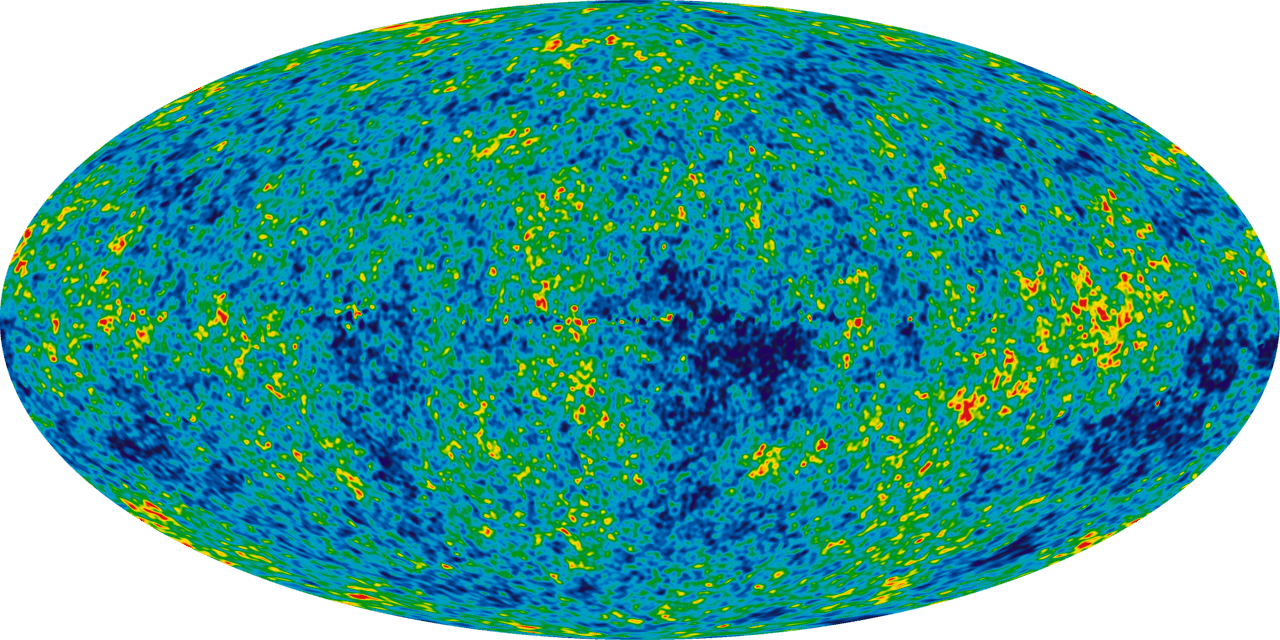
Inflation also addresses the flatness problem, explaining why the universe appears flat and not curved, as well as the absence of magnetic monopoles, which grand unified theories predicted would be plentiful. During this period, quantum fluctuations were magnified, forming the seeds of all structures in the universe, from galaxies to clusters of galaxies. These fluctuations, frozen in as the universe expanded, laid down the very scaffolding of the cosmos as we know it.
The quark epoch (10⁻¹² to 10⁻⁶ s)
Following inflation, the universe entered the quark epoch, beginning at around 10⁻¹² seconds. It was during this time that the electroweak force split into two distinct forces: electromagnetism and the weak nuclear force. The universe was composed of an intensely hot and dense plasma of free quarks, gluons, leptons, and photons—conditions reminiscent of those briefly recreated in the Large Hadron Collider (LHC), albeit on an infinitesimally smaller scale.
As the universe cooled further by 10⁻⁶ seconds, quarks began to confine within protons, neutrons, and various mesons. This confinement is a critical step in the formation of matter as we know it, setting the stage for the eventual construction of atomic nuclei. The conditions during this epoch were crucial for defining the stability and interactions of the particles that make up all known matter.
Baryogenesis
Amid the chaotic early moments of the universe, a crucial asymmetry emerged between matter and antimatter. This process, known as baryogenesis, remains one of the most profound mysteries in physics, as it decided the matter-dominated universe we inhabit. The imbalance was remarkably slight—approximately one extra baryon per billion antibaryons. When matter and antimatter particles encountered each other, they annihilated, converting into radiation. However, the small surplus of baryons that evaded annihilation went on to form the protons and neutrons of every atom present today.
The mechanisms behind this asymmetry are still debated, but they must satisfy conditions outlined by Andrei Sakharov in 1967. These conditions include baryon number violation, C-symmetry and CP-symmetry violation, and interactions out of thermal equilibrium. Unraveling the intricacies of baryogenesis could potentially illuminate one of the universe's earliest and most crucial divergences.
Lepton epoch and neutrino decoupling (1 to 10 s)
As the universe continued to expand, reaching approximately one second in age, its temperature had decreased to about 10¹⁰ Kelvin. This period heralded the lepton epoch, characterized by the decoupling of neutrinos from the thermal bath of particles. Previously in thermal equilibrium with the rest of the universe, neutrinos now interacted so infrequently that they began to free-stream through the cosmos. This decoupling left behind a cosmic neutrino background, akin to the cosmic microwave background, which remains as a ghostly relic detectable in principle even today.
Simultaneously, the ratio of protons to neutrons stabilized at roughly 6 to 1, setting the stage for the conditions required for primordial nucleosynthesis. Between three and twenty minutes after the Big Bang, the first light nuclei—deuterium, helium-3, helium-4, and trace amounts of lithium-7—would form, building the chemical foundation for subsequent cosmic evolution.
Reflecting on this whirlwind tour of the first second of the universe, one might find the disproportionate impact of these early moments rather astounding. Nearly everything of cosmic importance—including the formation of galaxies, stars, planets, and life itself—unfolded in a universe whose properties were largely set in these initial fractions of a second. Yet this is not a quirk of nature but rather a testament to the profound influence of initial conditions. The high temperatures of the early universe facilitated processes that could never occur in cooler, more stable conditions, allowing for a complexity that the cooler, slower unfolding of history could only build upon.
References
- Guth, A. H. (1981). Inflationary universe: A possible solution to the horizon and flatness problems. Physical Review D, 23(2), 347–356.
- Sakharov, A. D. (1967). Violation of CP invariance, C asymmetry, and baryon asymmetry of the universe. JETP Letters, 5, 24–27.
- Planck Collaboration (2020). Planck 2018 results. VI. Cosmological parameters. A&A, 641, A6.
- Kolb, E. W., & Turner, M. S. (1990). The Early Universe. Addison-Wesley.


