
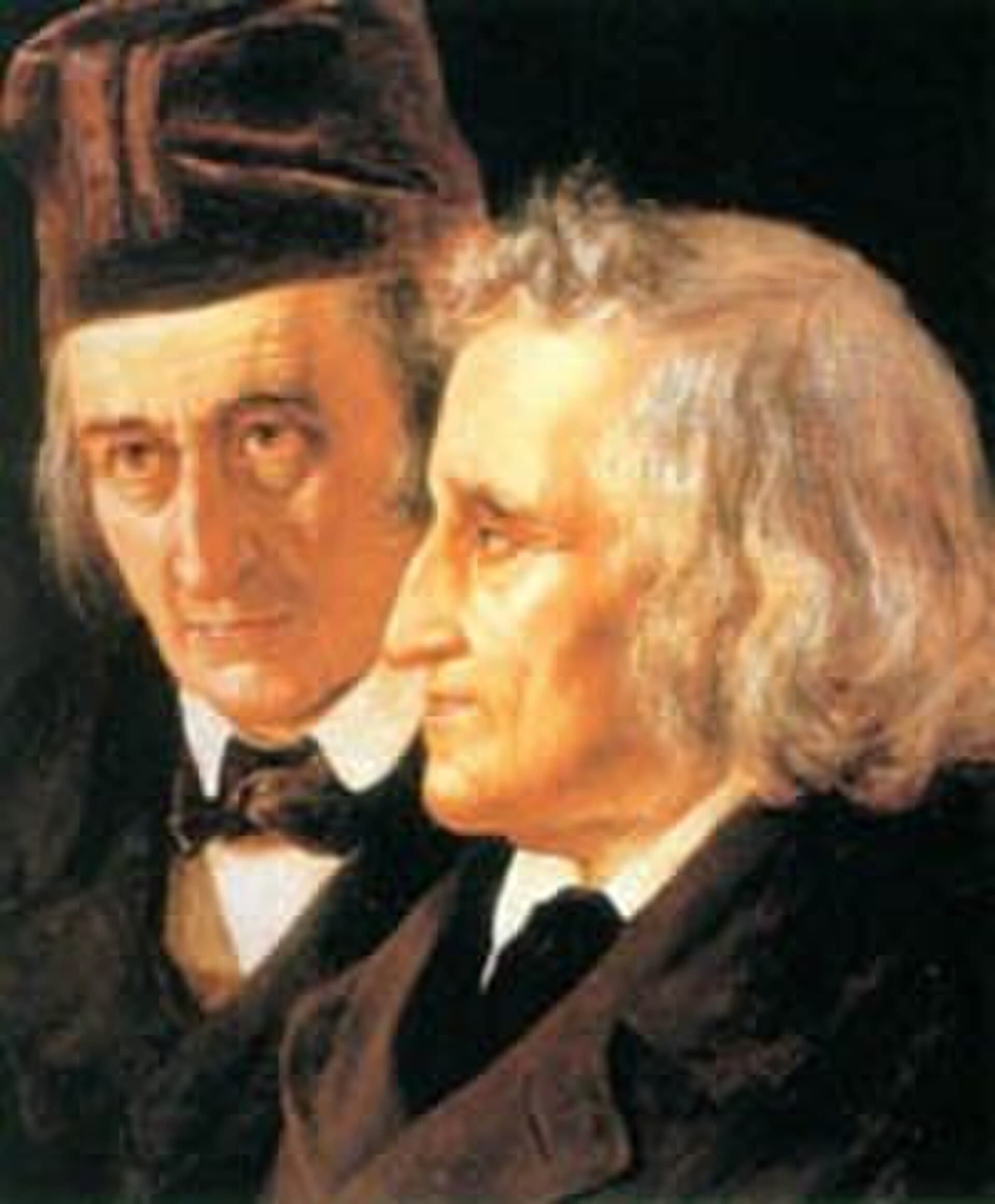
Jacob and Wilhelm Grimm are often reduced in popular memory to the collection of fairy tales that bear their name, immortalized by the likes of Disney. Yet, this is a simplification of their life’s work and motivations. Primarily philologists, the Grimm brothers were not just collectors of folk tales, but ardent scholars engaged in a larger intellectual pursuit: defining what it meant to be German in a landscape where Germany as a unified nation did not exist. Their pursuit was not limited to folklore; it was a grand project that included philology, linguistics, and the monumental task of producing a comprehensive dictionary. The Kinder- und Hausmärchen, first published in 1812, was merely a facet of this larger nationalist and scholarly ambition.
The political moment

The early nineteenth century was a turbulent time for the German-speaking world, which consisted of numerous small states and principalities under the shadow of Napoleonic conquests. In the aftermath of Napoleon’s defeat, the German Confederation was established, a loose association that lacked true unity. In this fractured political landscape, language emerged as a crucial element in the quest for national identity. Influenced by the Romantic nationalism of the era, the Grimm brothers saw language as a unifying force, an idea echoing Johann Gottfried Herder’s earlier collection of folk songs, *Volkslieder*. The Grimms' Kinder- und Hausmärchen was not just a collection of fairy tales but a deliberate effort to document and preserve the oral traditions of a people perceived to share a common linguistic heritage. By presenting these tales as the voices of the German Volk, the Grimms were making an implicit argument for the existence of a cultural and linguistic unity that transcended political boundaries.
The first edition of the Kinder- und Hausmärchen was framed as a collection of the authentic oral tradition. In the preface, the Grimms articulated their intention to capture the purity of the German language as spoken by the common folk. However, this authenticity claim was more complicated than it appeared. The brothers did not merely record tales verbatim from peasants in remote villages, as popular imagination might suggest. Their primary informants were, in fact, educated middle-class women, such as Dorothea Viehmann, who were themselves part of the literate bourgeoisie. This fact complicates the notion of the tales as purely 'folk' creations, suggesting instead a dynamic interplay between oral tradition and literate reinterpretation. In their collection, the Grimms were not simply passive recorders but active participants in shaping what would come to be viewed as a national literature.
What they actually did with the tales

Wilhelm Grimm, in particular, played a significant role in the evolution of the tales from their initial collection to the versions that are widely recognized today. Over seven editions, from 1812 to 1857, Wilhelm revised the tales extensively. This process involved toning down or removing elements of eroticism and violence, sharpening moral lessons, and smoothing linguistic variations to create a more coherent and homogeneous text. Such modifications were not mere cosmetic adjustments but part of a deliberate editorial strategy to align the tales with the prevailing bourgeois values and the Romantic ideals of the time.
The notion of the Grimms as unbiased collectors of folklore is largely a retrospective construction. As Maria Tatar points out in her analysis, *The Hard Facts of the Grimms' Fairy Tales* (2003), the brothers were crafting a version of the German cultural heritage that suited their ideological aims. The tales, in their final published form, reflect not only the influence of Romantic nationalism but also the Grimms’ own views on morality, family, and social order. Their editorial choices reveal a conscious effort to create a canon of narratives that would serve as moral and cultural education for the burgeoning German middle class. The tales thus became vehicles for socialization and identity formation, rather than mere reflections of an unmediated oral tradition.
Grimm's Law
Beyond their work on fairy tales, the Grimms made seminal contributions to the field of linguistics, particularly through Jacob Grimm’s formulation of what became known as Grimm's Law. Published in 1822 in the second edition of his *Deutsche Grammatik*, this law described the systematic consonantal shifts that differentiated the Germanic languages from their Proto-Indo-European antecedents. Jacob's insight demonstrated for the first time that linguistic change followed discernible patterns and rules, a revelation that laid the groundwork for historical linguistics as a scientific discipline.
Grimm’s Law articulates the First Germanic Sound Shift, which can be exemplified by several key transformations. One such example is the shift from the Proto-Indo-European word for 'father,' *pater*, which became *fader* in early Germanic languages, illustrating the shift of the voiceless stop /p/ to the voiceless fricative /f/. Similarly, the word for 'hundred,' *centum* in Latin, became *hund-* in Germanic, demonstrating the shift of the voiceless stop /k/ to the voiceless fricative /h/. These examples underscore the regularity and predictability of linguistic evolution, challenging previous notions of language change as arbitrary or capricious.
The Deutsches Wörterbuch
The Grimm brothers' ambition extended beyond collecting tales and documenting phonetic shifts. In 1838, they embarked on what would become one of their most monumental projects: the *Deutsches Wörterbuch*. This comprehensive dictionary of the German language was intended to be, in Jacob's words, a 'household book' for the nation, a linguistic and cultural repository that would serve as a touchstone for German identity. The brothers saw this project as a continuation of their efforts to codify and preserve the German language and culture in a time of political fragmentation.
Tragically, neither brother lived to see the completion of the dictionary. Wilhelm died in 1859, and Jacob followed in 1863, leaving the dictionary unfinished with the entry for 'Frucht' open on Jacob’s desk. The project was eventually completed in 1961, after a staggering 123 years of work by numerous scholars and institutions. This long timeline mirrors the expansive nature and complexity of the German language itself. The *Deutsches Wörterbuch* stands in contrast to the Oxford English Dictionary, which, while similarly ambitious, was completed in a much shorter timeframe. The dictionary not only catalogued words but also aimed to reflect the historical depth and richness of German, capturing the evolution of its usage over centuries.
How the brothers shaped 'standard' German
The Grimm brothers’ influence on the German language extended beyond their scholarly pursuits. Their work, particularly in editing and standardizing texts, played a significant role in shaping what we now consider 'standard' German. By ironing out dialectical variations in their fairy tale collections and other writings, the Grimms contributed to the establishment of linguistic norms that would later inform the development of a standard literary German.
This standardization was not merely an academic exercise but part of a broader cultural project. The Grimms, through their editorial choices and philological work, sought to create a cohesive linguistic identity for a people spread across disparate regions and dialects. Their influence can be seen in the conventions of modern German orthography and grammar, which owe much to their meticulous attention to linguistic detail. By providing a model of language that was both accessible and authoritative, the Grimms helped lay the foundation for the literary and cultural cohesion of the German-speaking world.
When modern readers refer to Disney's Cinderella as a 'Grimm fairy tale,' they acknowledge a lineage that is more than just literary. It is a lineage deeply intertwined with the politics of nation-building and cultural identity. The original collection of tales was not merely about preserving folklore; it was about crafting a narrative of what it meant to be German. The fact that the tales have outlasted the political context of their creation speaks to the enduring power of storytelling and its ability to transcend the immediate circumstances of its inception. As we continue to engage with the Grimms' work, we are reminded of the complex interplay between language, culture, and politics in the shaping of national identity.
References
- Zipes, J. (2014). The Original Folk and Fairy Tales of the Brothers Grimm. Princeton University Press.
- Grimm, J. (1822). Deutsche Grammatik, Band I (2nd edition, contains the consonant-shift table).
- Deutsches Wörterbuch (online via Trier University).
- Tatar, M. (2003). The Hard Facts of the Grimms' Fairy Tales. Princeton University Press.


