
Cairo, July 1324. The city was a hub of commerce and culture, a vital stop on the trade routes linking sub-Saharan Africa with the Mediterranean world. Into this thriving metropolis came Mansa Musa, the ninth Mansa of the Mali Empire, resplendent in his regal grandeur and accompanied by an entourage of staggering proportions. His journey from Niani, the empire's capital, had already stretched over eight arduous months. Now, as he paused on his pilgrimage to Mecca, the city of Cairo witnessed a spectacle unlike any other. The chronicles of the time describe a caravan of 60,000 people, including 12,000 enslaved attendants, each adorned in fine silks and bearing golden staffs. The gold flowed freely from Musa's treasury, so much so that the influx of wealth triggered a dramatic devaluation of gold across Egypt, a financial reverberation that persisted for more than a decade. Such was the magnitude of Musa's wealth, and such was the profound impact of his brief visit to Cairo.
Who Mansa Musa was
Born around 1280, Mansa Musa ascended to the throne in 1312, inheriting an empire already formidable under his predecessors. The Mali Empire, at its zenith, was a vast dominion spanning modern Mali, Senegal, Mauritania, Burkina Faso, Niger, and Nigeria. This expansive territory was not merely a collection of lands; it was a vibrant hub of commerce, culture, and innovation. The empire's wealth was drawn from its control over the gold-producing regions of Bambuk and Bure, as well as the salt mines at Taghaza, precious commodities that flowed along the trade routes connecting the empire to North Africa and the Mediterranean.
Timbuktu, Gao, and Djenne—great trading cities along the Niger River bend—became synonymous with wealth and learning under Musa's reign. Modern Mali derives its name from this illustrious empire, a testament to its enduring legacy. These cities were not merely trading posts but also centers of scholarship and culture. The Mali Empire's influence extended far beyond its borders, reaching the ears of distant lands through the stories and accounts of its opulence and Musa's legendary pilgrimage.

Why he was so rich
The source of Mansa Musa's astounding wealth lay in gold, a resource that the Mali Empire had in abundance. During his reign, Mali controlled the majority of West Africa's gold production at a time when European demand was surging. New coinages, like the Florentine florin in 1252 and the Venetian ducat in 1284, required gold, and the Mali Empire was perfectly positioned to meet this demand. While modern estimates of Musa's wealth often descend into hyperbole—some claiming his fortune would equate to $400 billion today—these figures are speculative at best. What is certain, however, is that by the standards of the 14th-century world economy, Musa's wealth was unprecedented.

Contemporary chroniclers like Al-Umari provide accounts that give a sense of the vastness of his riches. They speak of Musa's holdings in the order of 100 tonnes of gold, a staggering amount that underscores the economic might of the Mali Empire. While the exact figures may be debated, Musa's reputation as one of history's wealthiest individuals is well-founded, rooted in the empirical realities of his time.
The hajj of 1324
The hajj of 1324 was a seminal moment in history, not only for Mansa Musa but for the world beyond the borders of his empire. His journey to Mecca marked the first significant encounter between Mali and the broader Islamic world that was documented extensively. Al-Umari, an Egyptian official, recorded much of what we know about Musa's pilgrimage, providing invaluable insights into the grandeur of his expedition and the profound impact it had on those who encountered it.
Musa's caravan set out from Niani and traversed the vast Sahara, a feat of logistical and organizational prowess. His stop in Cairo lasted three months, during which his liberal distribution of gold astonished and destabilized the local economy. Al-Umari's accounts detail not only the sheer scale of Musa's entourage but also the Mansa's embarrassment when his subordinates, unfamiliar with the nuances of Egyptian commerce, were outmaneuvered by local merchants. The hajj, completed in 1325, was as much a statement of the Mali Empire's wealth as it was a spiritual journey.
What he brought back
Upon his return from Mecca, Mansa Musa brought with him more than just tales of his pilgrimage. He met the renowned Andalusian architect, Ishaq al-Tuwajin, also known as Abu Es Haq Es Saheli, and reportedly compensated him handsomely to accompany him back to Mali. It is a robust, though debated, tradition that credits Es Saheli with the design of the Djinguereber Mosque in Timbuktu, built around 1327, a structure that remains a symbol of Mali's Islamic heritage.
Beyond architecture, Musa's return heralded a new era of intellectual and cultural flourishing in Mali. He brought with him scholars, books, and Islamic legal practitioners, laying the groundwork for an intellectual milieu that would later support the Sankoré madrasa. Timbuktu, under Musa's patronage, evolved into a beacon of learning, attracting scholars from across the Islamic world and contributing to its later reputation as a centre of scholarship and erudition.
What Europe knew
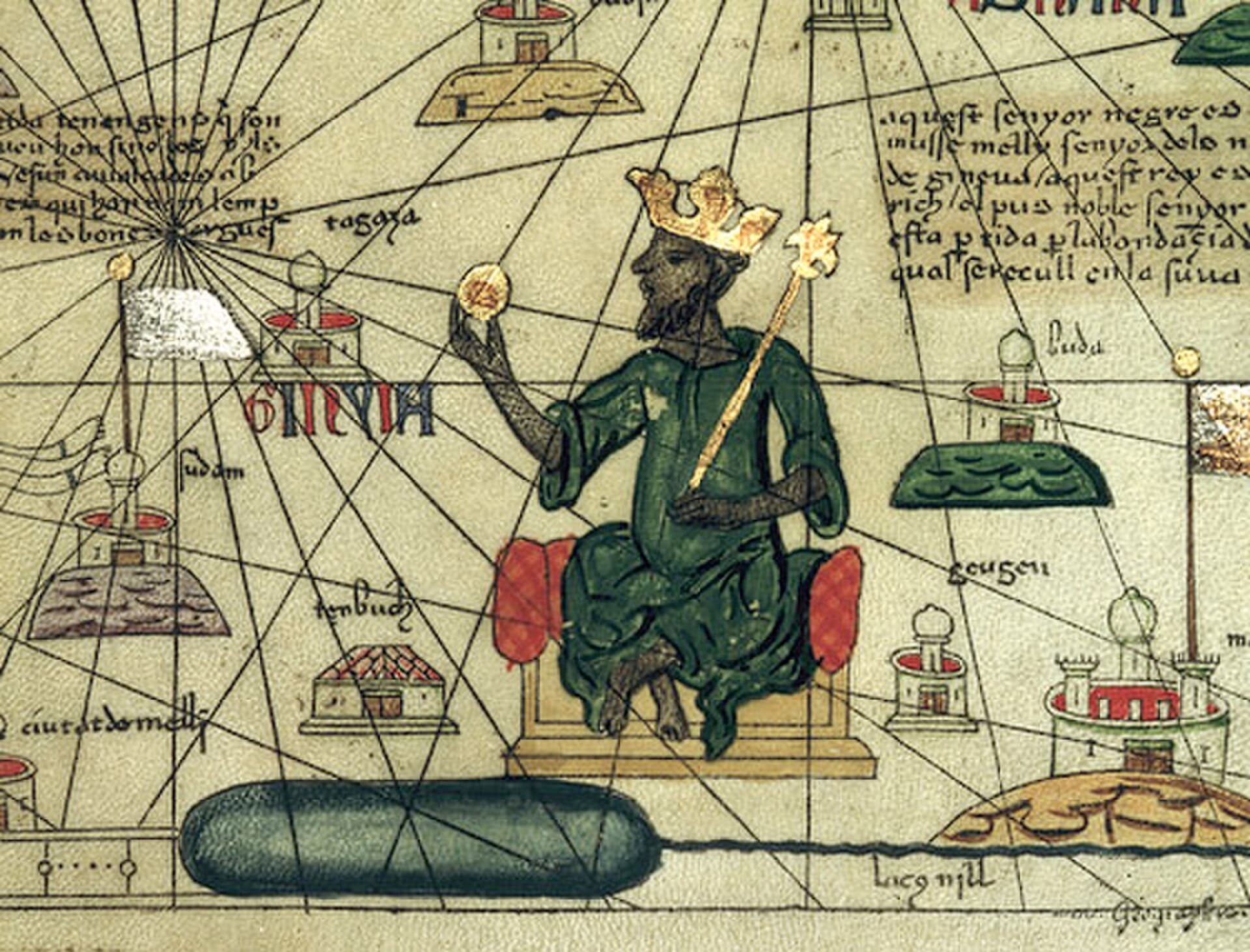
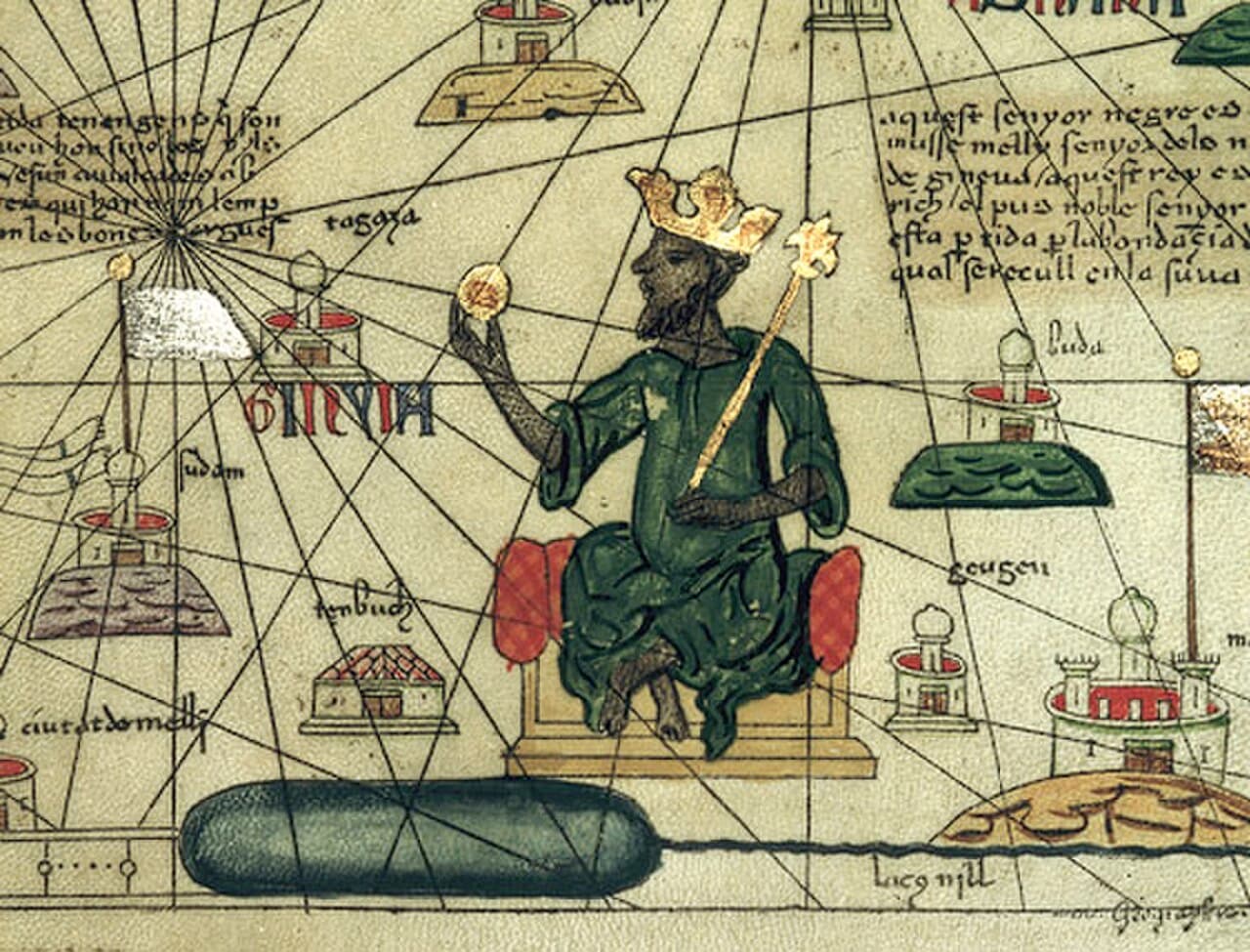
European awareness of Mansa Musa and the Mali Empire came through the lens of maps and manuscripts. The 1375 Catalan Atlas, crafted by Abraham Cresques in Majorca, presents one of the earliest European depictions of an African king. Musa is portrayed seated on a throne, holding a gold nugget, with a caption that identifies him as 'the richest and most noble king of all this region by reason of the abundance of gold which is gathered in his country.' This depiction marked a significant moment when the Mali Empire emerged onto the European consciousness, not merely as a distant land but as a realm of immense wealth and influence.
This representation, occurring a generation before any direct contact between Europe and the empire, underscores the extent to which Musa's hajj and his empire's economic clout permeated the global imagination. The image stands as the first known European portrayal of an African monarch, solidifying Musa's place in the annals of both African and global history.
After Musa
Mansa Musa passed away around 1337, leaving behind an empire that continued to flourish for another century under his successors. However, the seeds of decline were already sown. Dynastic struggles began to weaken the empire's cohesion, while the rise of the Songhai Empire to the east posed a formidable challenge to Mali's dominance. Over time, the shifting sands of commerce and politics saw the trans-Saharan trade routes realign, further eroding Mali's economic foundation.
By 1468, Timbuktu had fallen to the Songhai, and in 1591, it succumbed to Moroccan forces. Though the Mali Empire as a political entity faded, the intellectual and cultural legacies remained. The libraries of Timbuktu, housing manuscripts from the 13th to 19th centuries, are a testament to the enduring scholarly tradition that Musa helped establish. These manuscripts continue to be catalogued, preserving the rich history of one of Africa's greatest empires.
Mansa Musa remains a figure of immense intrigue, his legacy oscillating between the realms of historical fact and folklore. Often depicted as the "richest man in history" or, conversely, as a semi-mythical African king, the records—carefully documented by Egyptian officials like Al-Umari and immortalised in European cartography—provide a nuanced picture of a ruler whose wealth and influence were both extraordinary and tangible. The truth of his reign, like all history, is as fascinating in its complexity as the myths are in their grandeur.
References
- Al-Umari, S. (c. 1338). Masalik al-absar fi mamalik al-amsar (Pathways of the Eyes Through the Kingdoms of the Capitals). Translated extracts in Levtzion & Hopkins (1981).
- Levtzion, N., & Hopkins, J. F. P. (Eds.). (1981). Corpus of Early Arabic Sources for West African History. Cambridge University Press.
- Niane, D. T. (1965). Sundiata: An Epic of Old Mali (oral tradition, translated by G. D. Pickett). Longman.
- Gomez, M. A. (2018). African Dominion: A New History of Empire in Early and Medieval West Africa. Princeton University Press.


