

A photograph taken in 1910 shows a man sitting by the Chusovaya River in the Urals. He wears a dark blue cap and a blue work jacket, his beard mottled with red. Sunlight illuminates his cheek, and behind him the river flows, bordered by a dense, wooded bank. The caption that accompanies this image, written by the photographer Sergei Mikhailovich Prokudin-Gorsky, identifies him simply as a 'switchman' on the Murmansk railway. His name is lost to history, and yet his likeness has been preserved in full colour, a feat made possible by Prokudin-Gorsky's pioneering photographic techniques. This man, who likely died long before colour photography became commonplace, exists in a moment captured by a chemist who solved one of the era's most challenging technical problems. His image is one of approximately 2,600 surviving Prokudin-Gorsky negatives, now housed in the Library of Congress, scanned and digitally assembled into the vibrant images that the photographer himself envisioned.

The chemist

Born in 1863 near Vladimir, Sergei Mikhailovich Prokudin-Gorsky was destined for a life that intertwined science and art. Coming from a noble family, he was afforded the opportunity to study chemistry in Saint Petersburg under Dmitri Mendeleev, the architect of the periodic table. His quest for knowledge led him further afield to Berlin, where he studied under Adolf Miethe, a prominent figure in the experimental realm of colour photography. The fundamental challenge of early colour photography was that photographic emulsions of the time were not naturally panchromatic; they responded unevenly to different wavelengths of light. Prokudin-Gorsky adopted the three-colour method conceived by James Clerk Maxwell in 1861. Maxwell's approach, which involved capturing three black-and-white images through red, green, and blue filters, provided the theoretical underpinning for Prokudin-Gorsky's work.
By 1905, Prokudin-Gorsky had refined this method into a practical technique using a custom-built camera. His camera exposed a single tall glass plate three times in rapid succession through red, green, and blue filters. These exposures had to occur within seconds of each other, a necessity to ensure that the subject did not move between frames, thus preserving alignment for later reconstruction. Once the plates were developed, the images were projected using a magic-lantern projector equipped with corresponding colour filters, revealing a colour image. The photographic emulsions, the chemistry of the time, and the precision required for the method were daunting, yet Prokudin-Gorsky's results were nothing short of extraordinary.
The commission
In 1909, Prokudin-Gorsky presented some of his colour transparencies to Tsar Nicholas II at the Tsarskoye Selo palace. Captivated by the vivid depictions, the Tsar commissioned him to undertake a grand photographic survey of the Russian Empire. The assignment was to capture the diverse peoples, landscapes, industries, and architectural marvels of the empire in colour—a task that reflected both imperial ambition and scientific curiosity. The Ministry of Transport provided Prokudin-Gorsky with a railway carriage fitted as a mobile darkroom. This rolling laboratory allowed him to develop his glass plates on-site, a crucial capability given the temperamental nature of photographic chemicals and the vast distances he travelled.
From 1909 to 1915, Prokudin-Gorsky journeyed extensively, from the Caucasus and the Urals to Turkestan and the remote White Sea coast, documenting a world on the brink of transformation. His project aimed to compile a 100-volume photographic history of the empire, but it was cut short by the upheavals of World War I and the Russian Revolution. Nevertheless, Prokudin-Gorsky managed to capture approximately 3,500 images, an unprecedented visual record of the time.

What he photographed
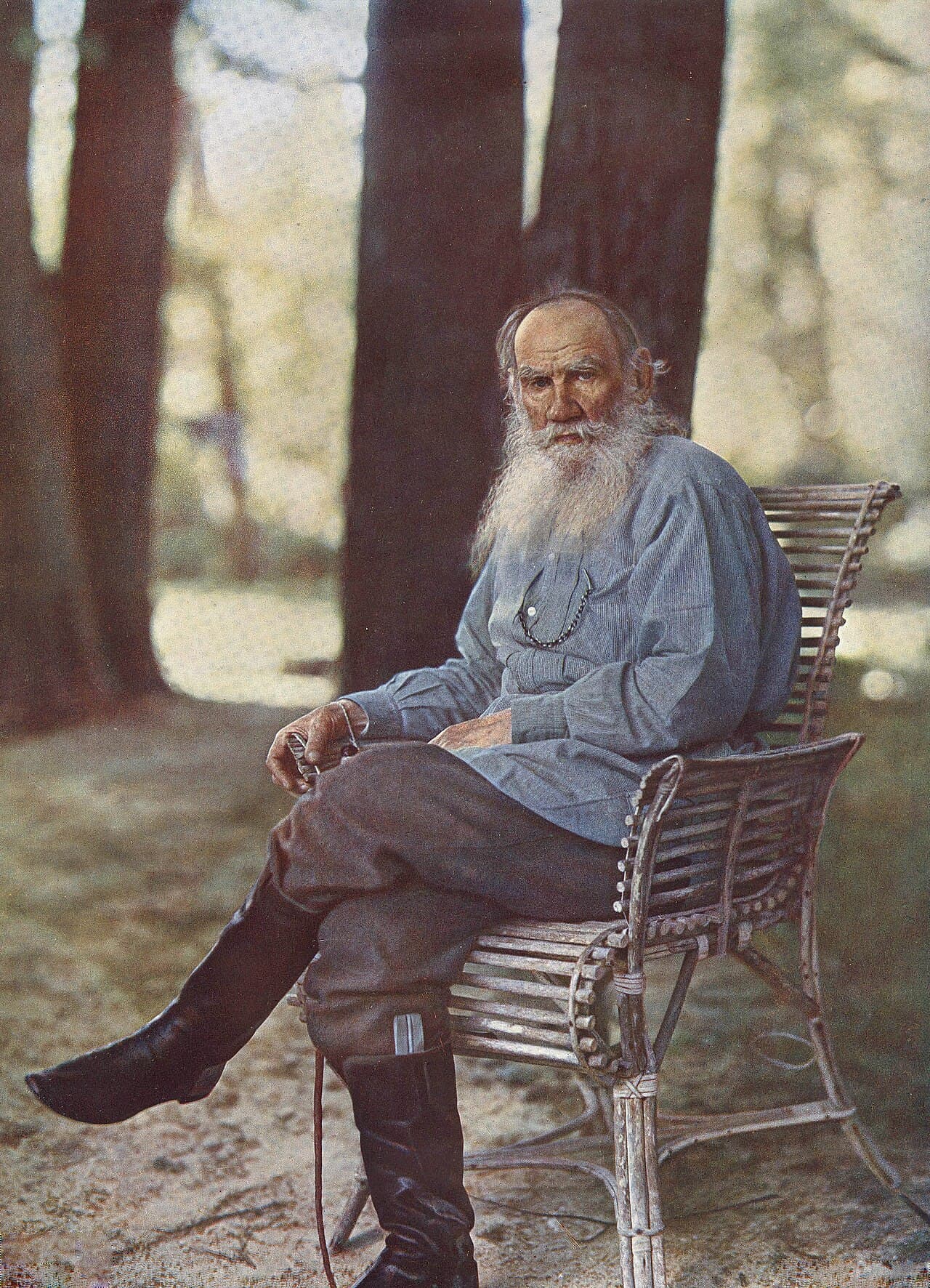
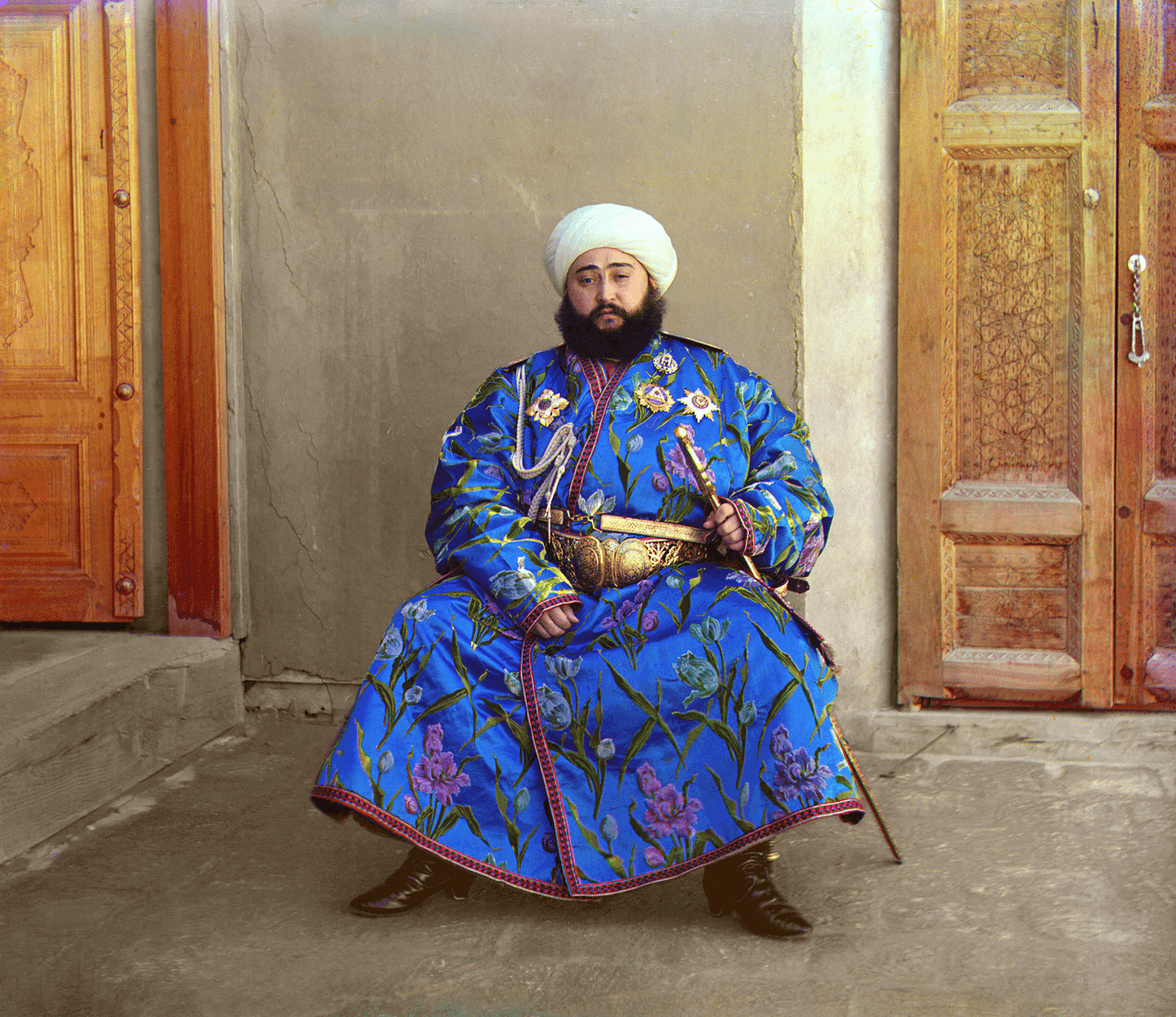
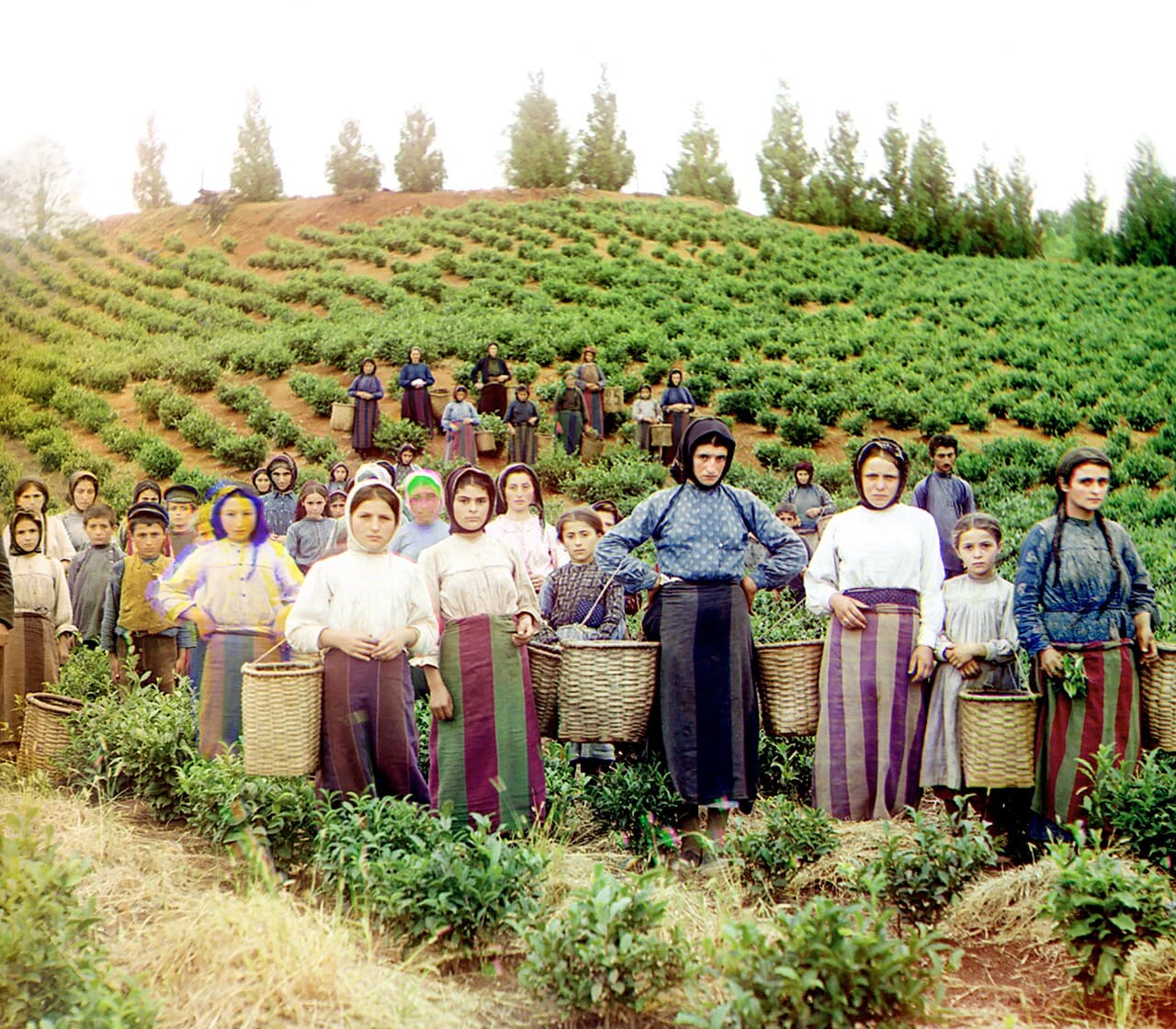
The subjects of Prokudin-Gorsky's lens were diverse and often unexpected. In Georgia, he photographed tea-pickers; in Bukhara, silk-weavers. He chronicled the construction of the Trans-Siberian Railway, capturing not just the engineering marvels but also the human toil behind them. His camera found its way into village schools, where he documented teachers and their pupils, and into the lives of soldiers and ethnic minority leaders, whose faces tell stories beyond words. His photographs of church interiors are hauntingly beautiful, capturing iconostases illuminated by flickering candlelight. Among these are the only known colour photograph of Leo Tolstoy, taken in 1908 at Yasnaya Polyana, and a portrait of Emir Said Mir Mohammed Alim Khan of Bukhara from 1911.
The breadth of his work is further exemplified by photographs of Old Believer monks at a monastery on Lake Onega, and nomadic Kazakh families on the steppe. He captured the vibrancy of merchant streets in provincial towns and ascended bell towers for aerial views that reveal the sprawling complexity of Russian settlements. Prokudin-Gorsky's work provides an unmatched colour record of the pre-revolutionary Russian Empire—a world on the verge of irrevocable change.
The technical strangeness
Prokudin-Gorsky's photographs, when viewed as negatives, appear as three vertically stacked monochrome images. The plates themselves do not contain colour; the magic is in how the three images align to reproduce it. For the images to reveal their colours, they must be projected through red, green, and blue filters that correspond to the original exposures. During Prokudin-Gorsky's time, this was achieved using a specially designed magic-lantern projector. The complexity of his method, though archaic by modern standards, mirrors the principle behind contemporary LCD screens, which display images by varying the intensity of red, green, and blue subpixels.
When the Library of Congress scanned the surviving negatives in 2000, they embarked on a digital restoration journey that would bring Prokudin-Gorsky's vision to fruition. The digital community used software to meticulously register the three frames and correct for any plate damage, ultimately producing images that faithfully represent the photographer's original intent. Through the serendipity of technological evolution, screens today recreate these images with a fidelity that Prokudin-Gorsky could only have dreamt of.
What can go wrong
The challenges of Prokudin-Gorsky's method were not just technical but also logistical. Many of his photographs were taken in dynamic settings—bustling marketplaces, lively streets, and on ships where movement was inevitable. In these instances, ghosting artifacts appear in the images, with subjects who moved between exposures leaving traces of coloured halos or blurred outlines. Such artefacts, while technically imperfections, serve as reminders of the technique's nuances. They capture the fleeting moments of life in the early 20th century in a way that unavoidably mixes the passage of time with static images.
Prokudin-Gorsky was adept at selecting subjects that mitigated these issues. He favoured stationary objects such as architecture and posed portraits. However, in uncontrollable scenes, such as a famous photograph of dock workers loading a barge on the Volga, ghosting occurs. The image captures several workers as colour blurs, unintentionally documenting the exact moments across which each exposure was made. These imperfections are not errors but rather a signature of the photographic method—an artistic touch that adds to the historical texture of the images.
What happened to the plates
After the Russian Revolution, Prokudin-Gorsky fled the turbulent landscape of his homeland in 1918, ultimately settling in Paris. He carried with him the precious cargo of glass plates that chronicled the Russia he had known. In 1948, his sons sold around 2,000 of these plates to the Library of Congress, where they remained largely inaccessible until the dawn of the digital age. The turn of the millennium marked a pivotal point when the Library embarked on a project to digitise the collection, offering the world an opportunity to view these colour images for the first time as Prokudin-Gorsky had intended.
The digital restoration process involved aligning the three monochrome images and reconstructing the colour images using modern software, a task that required both technical precision and historical insight. What emerged from this effort was not only a visual record of a vanished empire but also a testament to the enduring power of Prokudin-Gorsky's vision. His chemistry, technique, and perseverance allowed these images to transcend their time, revealing the past in a manner that is remarkably alive today.
Consider again the switchman by the Chusovaya River. His image, captured in 1910, shows a moment of stillness amidst a changing world. The sunlight casts a warm glow on his cheek, his blue jacket and red beard rendered with an immediacy that makes him seem as though he could step out of the frame into the present. The Russian Empire, at that time, had six years left; the Tsar who commissioned Prokudin-Gorsky had eight. The man himself likely perished in the turmoil following 1917. Yet, through a series of fortunate preservations—Prokudin-Gorsky's chemistry, a railway-carriage darkroom, the Library of Congress's acquisition, and a digital reconstruction—the colours of his world are brought forward to us.
The preservation of these images is not simply a tale of technological triumph but also one of extraordinary continuity. Despite the historical upheavals, the Prokudin-Gorsky plates carried the colours of a bygone empire across a century, allowing us to witness a vanished world in the vivid hues of reality. Therein lies the true marvel: not in the miraculous, but in the unbroken chain that keeps these images alive.
References
- Library of Congress. The Empire That Was Russia: The Prokudin-Gorskii Photographic Record Recreated.
- Allshouse, R. H. (1980). Photographs for the Tsar: The Pioneering Color Photography of Sergei Mikhailovich Prokudin-Gorskii. Dial Press.
- Adamson, J., & Trumbo, J. (2021). Restoring Color: Computational reconstruction of Prokudin-Gorsky photographs. International Journal of Computational Photography, 12(3).
- Maxwell, J. C. (1861). On the Theory of Three Primary Colours. Proceedings of the Royal Institution of Great Britain, 3, 370–375.


