
At the NASA Jet Propulsion Laboratory in Pasadena, California, the air was charged with a sense of urgency in February 1977. Inside a modest office on the Caltech campus, Carl Sagan, then 42 years old, was surrounded by a clutter of records, photographic transparencies, audio tapes, and printed material. This was no ordinary task; Sagan had been asked to chair a committee with a singular mission: design a message to accompany the two Voyager probes scheduled for launch later that year in August and September. These spacecrafts were poised to embark on a 'grand tour' of the outer planets, utilizing gravity-assisted slingshot trajectories to propel themselves beyond the solar system and into the vast expanse of interstellar space. In doing so, they would become the first human-made objects to leave the heliosphere, their interstellar journey potentially enduring for millions, if not billions, of years. Sagan was deeply immersed in pondering what kind of message could endure such a timescale and, more critically, what it should convey. With a mere three months at his disposal, a six-member committee had been assembled to deliberate over the contents of a 12-inch gold-plated copper phonograph record—an artefact designed to be decipherable by any advanced civilization that might one day encounter it. Each Voyager probe would carry one of these records, and the task at hand was monumental: condense the essence of humanity into a few precious grooves.
What had been done before
The concept of sending messages aboard space probes was not entirely novel to NASA by the time the Voyager mission came into being. A few years earlier, in 1972 and 1973, the Pioneer 10 and 11 probes had blazed a similar trail. Each carried a plaque crafted from gold-anodised aluminium, measuring 22.9 by 15.2 centimetres—a collaboration designed by Carl Sagan, Frank Drake, and Linda Salzman Sagan. The Pioneer plaque was a compressed communiqué, a minimalist attempt to encapsulate humanity's essence in a handful of symbols. It featured a diagram of the hydrogen atom's spin-flip transition, intended as a universal measure of time and length, alongside a schematic map depicting the Sun's position relative to 14 pulsars, a galactic address of sorts. Additionally, the plaque bore a diagram of the solar system and silhouettes of a nude male and female human, with the male figure raising a hand in salutation. Despite its simplicity, the plaque sparked controversy—objections arose regarding the nudity and the gender representations, specifically the active gesture of the male compared to the passive stance of the female.
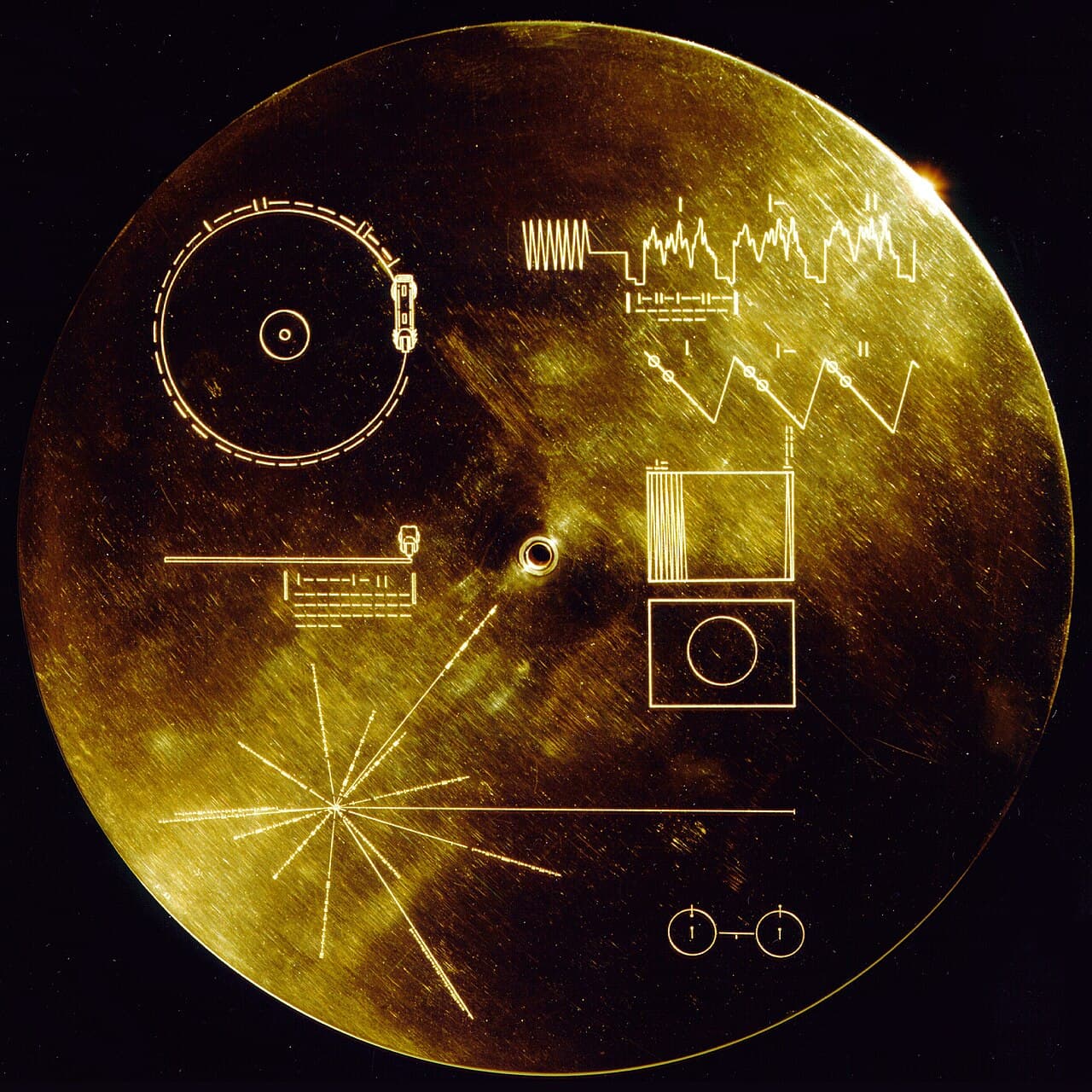
Aware of the criticism surrounding the Pioneer plaques, the Voyager committee sought to transcend these limitations by creating a more substantial message. Sagan and Drake, alongside their colleagues, envisioned a phonograph record as a richer medium. The chosen format was a 12-inch, 16⅔ rpm gold-plated copper disc, employing standard 1970s record-pressing technology. This slower-than-LP rotation speed maximized the record's capacity, allowing it to hold approximately 90 minutes of analogue audio and encoded photographic frames. The committee's decision was pragmatic—any civilization advanced enough to intercept the probe would, they assumed, possess the capability to decipher the playback instructions etched onto the record's cover. The Voyager Golden Record would thus strive to represent not just humanity's physical presence in the universe, but a broader cultural spectrum, offering sounds, images, and music as a testament to Earth's rich diversity.
What they put on it
The final compilation on the Voyager Golden Record was an ambitious tapestry of Earth's cultural and natural heritage. It commenced with greetings in 55 languages, a linguistic mosaic ranging from ancient Akkadian to modern dialects like Wu Chinese and Welsh. These were supplemented by audio essays from then-United Nations Secretary-General Kurt Waldheim and then-President Jimmy Carter, whose words offered a diplomatic overture to any potential extraterrestrial finders. Natural sounds followed—recordings of surf, thunder, bird calls, whale songs, the intimate sounds of a kiss, and the simple yet profound footsteps of human beings, laughter, and a heartbeat—all capturing the rhythm of life on Earth.
Musically, the record showcased 27 selections from a wide array of global cultures. It presented the high art of Bach with the Brandenburg Concerto No. 2, and the raw exuberance of Chuck Berry's 'Johnny B. Goode', alongside Stravinsky's avant-garde 'Rite of Spring', Beethoven's introspective late Quartet No. 13, and Mozart's timeless opera, 'The Magic Flute'. The musical journey extended to encompass Indian Hindustani raga, Senegalese drumming, the haunting harmonies of Bulgarian polyphony, and Aboriginal Australian songs—an attempt, albeit imperfect, to represent the diverse musical lexicon of humanity. The image selection posed its own challenges. Originally, the team intended to include a photograph of a naked man and woman, but concerns stemming from the Pioneer controversy led NASA officials to veto new nude depictions. As a compromise, silhouettes were used in some cases, and clothed figures in others, with the sole nude image being that of a fertilised egg cell. Frank Drake ingeniously encoded the analogue images into the record's audio track, employing a sequence of audio tones to represent pixel brightness—decipherable, the team believed, by any suitably advanced recipient. The instructions for playing the record, including the hydrogen atom's spin-flip diagram as a universal temporal reference, were etched into the record's case.
The curation crisis
The task of curating the contents of the Golden Record fell to a small but diverse committee, each member bringing unique expertise to the project. Alongside Carl Sagan, the team included Frank Drake, famed for his pioneering role in the search for extraterrestrial intelligence through Project Ozma in 1960, and Ann Druyan, a writer and creative director who would later become Sagan's third wife and a vital collaborator. Linda Salzman Sagan, Carl's then-wife and a multi-talented artist and writer, contributed her creative insights. Science writer Timothy Ferris took on the role of audio content producer, while artist Jon Lomberg was responsible for the design of the image content.
Constrained by a tight three-month deadline, the committee operated under immense pressure, and their decisions, while thoughtfully considered, inevitably bore the imprint of their time and place: 1970s America. Their criteria for selection sought to balance cultural representation—a task as subjective as it was monumental. The music had to span a broad spectrum of human cultures, though the final selection leaned heavily towards Western classical music, with African and Eastern European traditions receiving less attention. The sound effects aimed to evoke the human and natural experience without resorting to clichés, and the images needed to effectively communicate human biology, social structures, and material culture. A notable omission from the record was the Beatles. Despite the committee's desire to include 'Here Comes the Sun', legal complications with EMI/Apple Records—despite the band's own enthusiasm—prevented its inclusion. The Beatles' absence is a stark reminder of the limitations posed by intellectual property rights even in cosmic contexts. Criticism of the selection has emerged over the years, pointing to the overrepresentation of classical music and the underrepresentation of indigenous cultures. Chuck Berry's inclusion was a notable choice, yet no female soloists from popular music were featured. The committee's defence remains steadfast: with only ninety days, six individuals, and an endless array of possibilities, they curated the best record they could within the constraints they faced. The record, for better or worse, is a time capsule of its curators' vision.
Where they are now
Since their launch in late summer 1977, the Voyager probes have ventured further from Earth than any other human-made objects. Voyager 1, launched on 5 September 1977, now finds itself approximately 167 astronomical units from the Sun, equivalent to about 25 billion kilometres, or a staggering 23 light-hours away. On 25 August 2012, it made history by crossing the heliopause, the boundary where the solar wind gives way to the interstellar medium, thus entering interstellar space. Voyager 2, although launched earlier on 20 August 1977, took a slower path and reached the heliopause on 5 November 2018. Now, it is approximately 140 AU from the Sun.
Both probes continue to send back data, albeit with their plutonium-238 radioisotope thermoelectric generators now producing just a third of their original power. In 2026, they each provide around 240 watts, enough to keep a few instruments operational. However, the end of their missions looms around 2030, as their power diminishes below the threshold needed for scientific instruments. Voyager 1 is predicted to pass within 1.6 light-years of Gliese 445 in roughly 40,000 years, while Voyager 2 will come near Ross 248 around the same time. These distances, inconceivable on a human scale, underscore the minuscule chance of the probes being encountered by an intelligent extraterrestrial civilization. In this sense, the records aboard them are more a message to ourselves, a self-portrait of humanity as it was in 1977, rather than a serious attempt at communication with alien life.
What the record actually represents
The Voyager Golden Record has been the subject of various interpretations since its inception. Optimists see it as a hopeful gesture, a cosmic olive branch suggesting that humanity intends to endure long enough for other species to discover traces of its existence. Pessimists, however, might view it as a cultural insurance policy, a testament to who we were in case we extinguish ourselves and leave no other legacy. From a technical standpoint, the record represents an engineering marvel—packing an extraordinary density of information into a format designed to withstand geological timescales. Politically, it is an artefact of late-Cold-War America, reflecting the optimism of a Carter-era vision of humanity's potential for universal communication and understanding.
All these readings hold some truth. The Golden Record has become a touchstone for considering how we might represent ourselves to the cosmos. Subsequent interstellar messaging projects, such as the 1999 Cosmic Call broadcasts and the 2008 'A Message From Earth' directed at Gliese 581c, as well as various Messaging Extraterrestrial Intelligence (METI) proposals, have all echoed the Voyager records as a benchmark. The 2017 publication of the records' content online, accompanied by a high-quality digital remaster, has further democratized access to this once-esoteric artefact. A Kickstarter campaign that same year, which raised $1.36 million, brought the record back to life in a nostalgic vinyl rerelease, wildly exceeding its fundraising goals. The Golden Record was never meant for broad terrestrial audiences, yet it has become one of the most enduring portraits of humanity, capturing the spirit of the 1970s in a way that continues to resonate.
The two Voyager probes, now at a staggering distance of 25 billion and 21 billion kilometres from Earth, are quiet save for their faint radio signals, which in 2026 require the largest dishes of NASA's Deep Space Network to detect. The records, affixed to the side of each spacecraft, lie in the near-vacuum of space at temperatures barely above absolute zero, voyaging through interstellar space at 17 kilometres per second relative to the Sun. The phonograph grooves, etching the cultural and biological essence of humanity into a golden disc, remain intact, projected to persist for billions of years. They hold within them Bach's Brandenburg Concerto No. 2, Chuck Berry's 'Johnny B. Goode', and Ann Druyan's brainwaves—captured while she mused about her love for Carl Sagan—a unique testament to the human experience. They also carry the calls of a Bushman hunter, the harmonies of a Bulgarian choir, the hum of a truck from 1977, and a child's 'hello' in fifty-five languages. The instructions, etched in gold-plated aluminium, endure as a silent testament to the era's ambition. Since 1977, the records have been doing nothing but travelling outward, patiently preserving their message. They will continue to do so for the foreseeable future, embodying the most patient object humanity has ever crafted. Whether they will ever be found is a question unanswerable within any conceivable human timeframe. Yet the records' purpose transcended the search for answers; it lay in the act of creation itself. In the spring of 1977, a small group of people, with limited time and resources, attempted to encapsulate who we were. Their endeavour now continues, beyond the solar system, a silent testament to our fleeting moment in the cosmos.
References
- Sagan, C., Drake, F. D., Druyan, A., Ferris, T., Lomberg, J., & Sagan, L. S. (1978). Murmurs of Earth: The Voyager Interstellar Record. Random House.
- Ferris, T. (2017). How the Voyager Golden Record Was Made. The New Yorker, 20 August 2017.
- Druyan, A. (2003). The Universe Speaks: Voyager Golden Record. NASA archives.
- Lomberg, J., & Sagan, C., eds. (1978). The Voyager Golden Record (technical specifications). NASA JPL.


